
A Q&A with Dr. Howard Hu
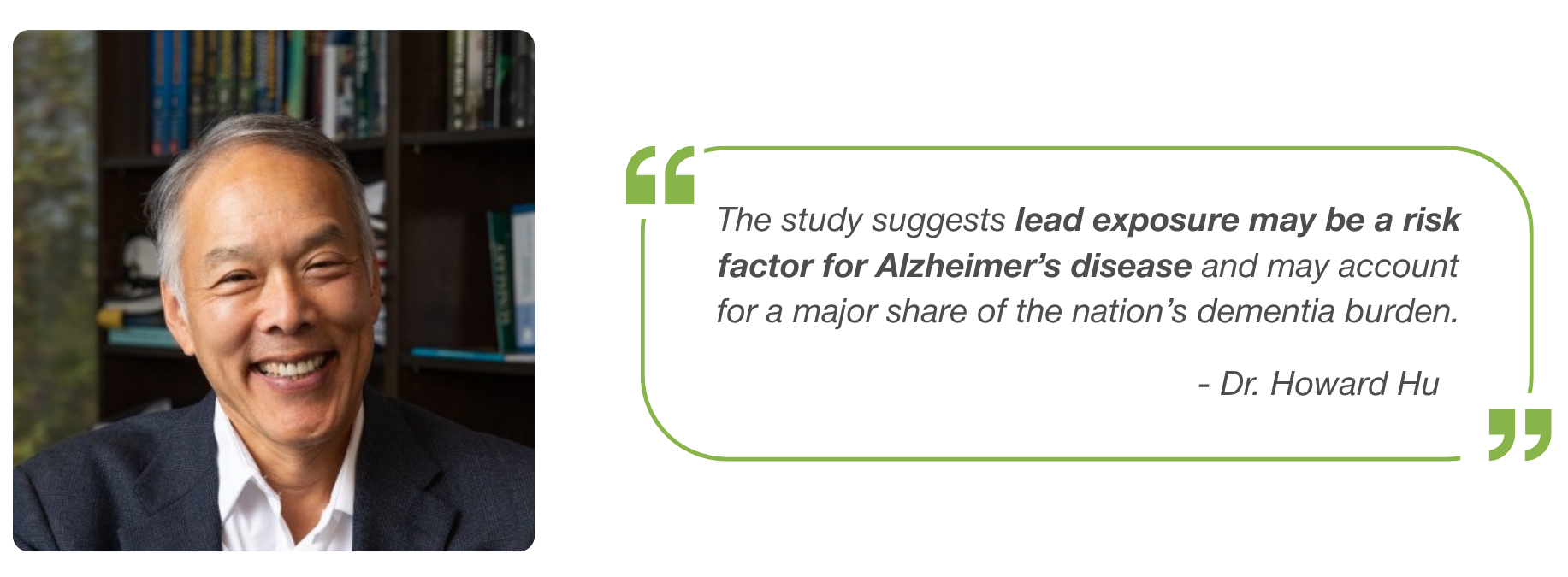
Most people think of lead poisoning as a problem that only affects children. A new study suggests its effects may follow us into old age. We asked Dr. Howard Hu, Pure Earth’s Senior Science Advisor and a leading researcher on lead and chronic disease, what the findings mean and what comes next.
A recent study by Wang et al. finds evidence that cumulative lead exposure in life may be a leading cause of Alzheimer’s disease and other forms of dementia. What did the researchers find, and why has it attracted so much attention?
The research team found that a tool for estimating bone lead levels, a marker of lead exposure accumulated over many years, was a strong predictor of the development of Alzheimer’s Disease, as well as general dementia, among participants of a national study of Americans that is known to be representative of the general US population and the source of many rigorous studies.
Many people in the field think of lead poisoning as a threat only to children’s cognitive health. What does this research tell us about the long-term effects of lead exposure across the lifespan and for chronic disease?
The evidence for chronic lead exposure having a long “tail” of adverse health consequences later in life has been building for years, with such exposure posing a major risk for heart attacks and increased mortality from cardiovascular disease now an accepted fact, and the evidence base for adverse impacts on neurodegenerative disease steadily increasing. The evidence includes basic research studies demonstrating lead’s impact on many cellular and molecular processes that promote neurodegeneration as well as rigorous, well-designed epidemiological studies such as this one.
This study used estimated bone lead rather than current blood lead levels. Why is bone lead such an important tool for understanding chronic exposure and disease risk as opposed to blood lead levels?
The study used a tool for predicting bone lead levels. The tool was developed based on research that used x-ray fluorescence methods to make direct measurements of bone lead levels, and then creating an algorithm to predict bone lead levels based on blood lead levels and a number of other variables that were subsequently validated and shown to perform well in predicting risk of hypertension and cardiovascular disease. Bone lead levels are a great “dosimeter” for chronic lead exposure because when an individual is exposed to lead, about 15% of the internalized dose of lead is incorporated into the skeleton, where it persists for decades, unlike blood lead levels, which decrease relatively quickly once exposure is removed.
I’m proud that a research team I led did much of this work: establishing bone lead as a dosimeter of chronic exposure, developing XRF instruments to measure it directly, applying those measurements in epidemiological studies, building the prediction algorithm, and showing that it sharpened our understanding of lead’s impact on cardiovascular mortality.
Dementia and Alzheimer’s disease impose enormous costs on families, healthcare systems, and economies. If future research confirms a link between lead exposure and dementia, what could that mean for the economic case for lead poisoning prevention?
Huge. Alzheimer’s and other neurodegenerative diseases typically arise later in life. So, although the U.S. and other high-income countries have steadily reduced lead exposure by removing lead from gasoline, paint, plumbing, and other products, we will keep suffering the “latent” effects of the chronic lead exposure we experienced in the 1950s, 1960s, and 1970s for many years to come.
How confident should we be in the connection between lead exposure and dementia? What evidence exists today, and what questions still need to be answered?
The evidence is clearly building, and, in my opinion, it’s not quite but almost sufficient to conclude that chronic lead exposure causes dementia. More research is needed, particularly with respect to epidemiological studies that show similar results as this study, and also in other populations, by other investigators, and using a variety of “tools” to estimate chronic lead exposure.
For people who were born before leaded gasoline was phased out, should this research change how they think about their health and aging? Is this something they can address?
At this point, there is no evidence that supports a particular strategy by which individuals born before 1980 or so can reduce the risk posed by their lead exposure for chronic disease such as Alzheimer’s or hypertension. On the other hand, all of these chronic diseases are multifactorial; lead is likely adding to the other risks that are known to be associated with the diseases. Thus, it makes sense to increase attention to “living healthy” by pursuing lifestyle changes known to reduce the risk of both cardiovascular disease and Alzheimer’s, including a healthy diet, regular exercise, reducing stress; and in particular for Alzheimer’s, keeping the mind “active.”
What does this finding mean at a time when more than 1 billion children have elevated levels of lead in their blood? If there’s one lesson policymakers, donors, and the public should take away from this research, what is it?
Lead exposure has a long “tail” of adverse health consequences, for adults as well as children, with impacts in terms of disease, suffering, and economic consequences that have some similarities to those of air pollution. Unlike air pollution, however, lead exposure has major adverse impacts on child intelligence and behavior; and it is invisible, silent, and odorless, making it critically important to advocate for testing, uncovering sources, and reducing them.
How should the community of practice better communicate this research to ensure the word gets out about this study?
We need to take this research beyond our own community of practice of lead and environmental health. The study suggests lead exposure may be a risk factor for Alzheimer’s disease and may account for a major share of the nation’s dementia burden, which makes it urgent news for people working in aging, dementia care, Alzheimer’s advocacy, and Alzheimer’s research. That field is large, well resourced, and actively searching for modifiable risk factors, and lead offers something rare: a risk factor that can be prevented with early detection and mitigation of exposures.
A Q&A with Dr. Howard Hu Most people think of lead poisoning as a problem that only affects children. A new study suggests its effects may follow us into old age. We asked Dr. Howard Hu, Pure Earth’s Senior Science Advisor and a leading researcher on lead and chronic disease,… Read More Advocacy and Awareness Raising, Interviews, Lead Pollution, Research The Pollution Blog [#item_full_content]